
Themed Resort Design: Key Principles for Immersive Experiences
Designing a themed resort looks like pure magic on a concept render: lush landscapes, sweeping architecture, and stunning lobbies that practically invite Instagram posts. But behind the beauty, themed resort design is a masterclass in spatial choreography, storytelling, and operational discipline.
Every architectural decision, material choice, and lighting cue has to work overtime. It has to advance the story, guide guests effortlessly through the property, keep back-of-house operations smooth, and create lasting memories that drive repeat bookings. That’s what separates themed hospitality from traditional hotels. Guests aren’t just booking a place to sleep; they’re buying exclusive access to an entirely different world.
When done right, a themed resort feels completely natural and immersive. When done poorly, it feels like a standard airport hotel wearing a cheap costume.
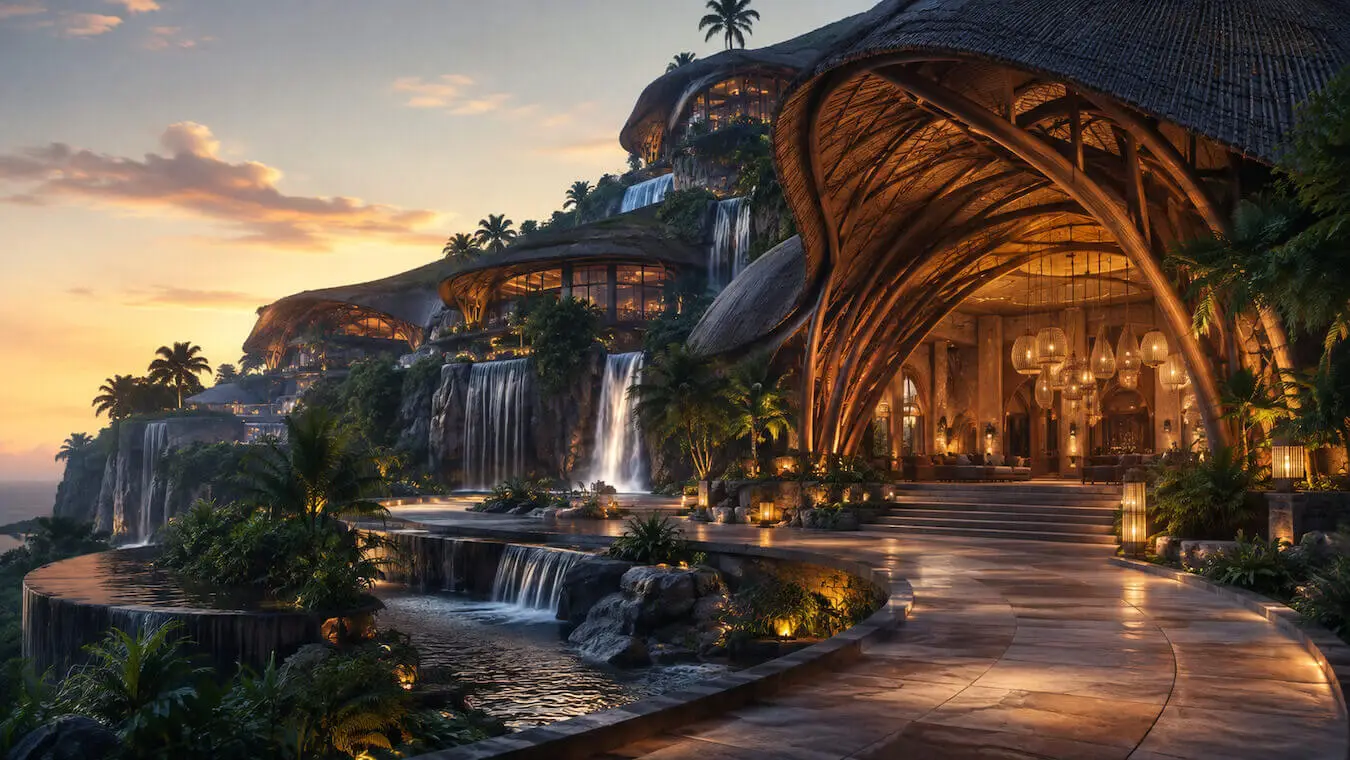
Table of Contents
What Truly Makes Resort Design Immersive?
Real immersion happens when guests step into an environment governed by its own internal logic, atmosphere, and emotional rhythm. It’s never about sticking decorative props onto a wall. It’s about mapping out every stage of the guest journey.
That journey starts long before check-in and extends far beyond checkout:
- The Approach: The visual buildup as guests near the property
- The Arrival: The threshold moment where the outside world fades
- The Reveal: The grand entrance or lobby opening scene
- Orientation: Intuitive layout that prevents decision stress
- Private Immersion: Corridors, guest rooms, and suites that continue the narrative
- Public & Leisure Zones: Restaurants, pools, bars, spas, and retail spaces
- Nighttime Transformation: How lighting, sound, and mood shift after dark
- The Departure: The final touchpoint that locks in the memory
In a world-class resort, no space is treated as an afterthought. A quiet corridor shouldn’t just be a walkway; it should build anticipation. A room shouldn’t just be comfortable; it should make guests feel like they’re sleeping inside the story.
The ultimate test of immersive design is simple: Does the magic hold up when guests leave the main lobby?
Moving Beyond the Visual Concept
Mood boards and high-resolution renderings are great starting points, but they aren’t the actual experience. A themed resort requires a central narrative engine strong enough to inform every single layer of design.
If your concept is an “Explorers’ Jungle Sanctuary,” that theme must dictate the architecture, material palettes, landscaping, acoustic design, staff attire, F&B menus, pool finishes, and room details. If the theme only lives in a lobby sculpture and a few wall graphics, guests will instantly feel the disconnect.
Themed design succeeds when the fantasy operates on clear rules:
- What raw materials exist in this universe?
- What color palettes feel natural to the environment?
- Is the architectural tone ancient, futuristic, organic, or playful?
- Who are we designing for: families, couples, thrill-seekers, or luxury travelers?
Without these rules, you end up with a random collection of neat ideas that never quite coalesce into a believable world.
Start with the Guest Promise
Before choosing stone samples, light fixtures, or floor plans, you have to answer one core question: What should people feel when they stay here?
It sounds simple, but it anchors the entire project:
- A family fantasy resort might promise awe, safety, and active discovery.
- A luxury eco-resort promises serenity, privacy, and deep connection to nature.
- A resort integrated with an aquarium promises curiosity, mystery, and the feeling of sleeping alongside marine life.
As industry insights on themed resort design often highlight, successful properties aren’t built around what guests see. They’re engineered around what guests want to experience. Commercially, this clarity is invaluable. A defined guest promise aligns audience targeting, room mix, amenities, pricing strategy, and entertainment programming right from day one.
For developers planning themed resorts, this guest promise becomes the foundation for every creative and commercial decision that follows.
Build Around a Central Narrative
A resort narrative doesn’t need a convoluted storyline with scripted characters. But it does need a solid thematic foundation, whether inspired by a local legend, a natural ecosystem, a historical era, or a fictional brand universe.
This narrative gives architects, interior designers, engineers, landscape artists, and operators a single source of truth.
Have in mind that restraint builds believability. If your resort centers on an underwater world, you don’t need plastic fish on every wall. Use organic curved architecture, blue-green light diffusion, wave-patterned textures, and acoustics that mimic underwater depth. Suggestion is always more powerful than obvious decoration.
Treat the Layout Like a Cinematic Sequence
The best themed resorts borrow heavily from film and theater. They realize guests experience physical space over time, making pacing and transitions vital.
- The Approach: The property builds expectation from a distance.
- The Threshold: Passing through an entrance that signals a transition.
- The Reveal: A breathtaking first impression in the lobby or central atrium.
- Orientation: Natural layout cues that guide guests without intrusive signs.
- Exploration: Courtyards, pools, restaurants, and hidden corners that reward curiosity.
- Private Sanctuary: Rooms and suites that continue the story on an intimate, calming scale.
Because guests stay for days rather than hours, every transition space must hold up under repeated use.
Let Resort Architecture Set the World’s Rules
Architecture is the very first physical signal of your concept. Before guests touch the furniture, taste the food, or hear the background music, they process the shape, scale, and silhouette of the buildings.
Resort architecture design sets the tone through:
- Rooflines and massing that carve out a unique skyline
- Intentionally framed views and sightlines
- The relationship between built structures, water, and terrain
- Natural day-to-night lighting potential
For large-scale destination projects, design and engineering must collaborate early. A dramatic silhouette is useless if it creates heat traps, maintenance nightmares, or awkward guest bottlenecks. The magic has to thrive alongside real-world operations.
Let Resort Interior Design Scale the Story Down
If architecture establishes the world, resort interior design is where the story gets personal. This is where guests touch materials, sit, sleep, dine, and notice the finer details.
Lobbies & Reception
The lobby must deliver a stunning visual reveal while quietly executing high-volume operations. Check-in flow, luggage routing, and seating must feel effortless. The design should hide the operational effort, not ignore it.
Guest Rooms & Suites
Rooms are where guest loyalty is won or lost. You don’t need a room packed with props; you need an atmosphere that feels connected to the property’s soul. Custom headboards, warm lighting, tactile fabrics, and subtle design cues keep the story alive while prioritizing comfort.
Themed Dining & Social Spaces
Food and beverage venues are major storytelling opportunities. Rather than designing isolated concepts that clash with the resort, each venue should feel like a distinct “neighborhood” within the same overarching world.
Corridors, Restrooms, and Transitional Spaces
These areas are easy to underfund. They are also where immersion often breaks. A corridor does not need the budget of a lobby, but lighting, carpet patterns, wall texture, signage, and sound control still matter. Restrooms should feel clean and practical, of course, but they should not suddenly look like they came from a different hotel.
Engage the Senses
Truly immersive design speaks to every sense:
- Tactile: Natural stone, warm timber, or cool brushed metal
- Acoustic: Soft water falls, custom ambient soundscapes, or natural wildlife audio
- Visual: Layered lighting, filtered daylight, and dramatic shadows
- Olfactory: Subtle, signature scents that trigger positive memory recall
The key here is restraint. Too much scent is irritating, loud audio is exhausting, and an overload of digital screens feels like an electronic trade show. Technology should support the environment, not scream for attention.
Root the Fantasy in Local Context
Even the most imaginative fantasy resorts benefit from a genuine sense of place. Integrating local climate strategies, native landscaping, regional stone, and traditional craftsmanship grounds the concept. Guests can instantly spot when a generic design has been copy-pasted onto a landscape.
By blending the core theme with local ecology and culture, the property feels authentic, sustainable, and distinctly tied to its environment. This is especially important for eco-themed resorts, where the story is often inseparable from the landscape, local materials, environmental responsibility, and the guest’s desire for a more meaningful stay.
Balance Immersion with Real-World Operations
A themed resort is an operational business first and foremost. Every creative decision has practical, back-of-house consequences:
- Housekeeping Routes: Can staff move efficiently without breaking the guest illusion?
- Material Durability: Will themed finishes withstand high humidity, pool chemicals, or heavy luggage?
- Maintenance Access: Can technicians access pumps, lighting, and AV systems without disturbing guests?
- Wayfinding: Is navigation intuitive, or are lost guests wandering into service areas?
Guest satisfaction depends on what happens when the resort is at 100% capacity, staff is busy, and the property has been operating for years. That is why development and operations should be considered from the earliest planning stages, not after the resort has already been designed.
Connect the Theme Directly to Revenue
Smart design directly supports the resort’s commercial engine. When the narrative influences the entire guest spend, it drives revenue across the property:
- Upgraded Accommodations: Premium themed suites and family room configurations
- Destination Dining: Signature bars and immersive restaurants that draw outside guests
- Integrated Attractions: Ticketed aquariums, water parks, or interactive play zones
- Targeted Merchandise: Retail items that feel like authentic souvenirs from the world
- Events & Packages: Seasonal overlays, corporate retreats, and celebratory packages
Guests book the room for the concept, spend more on dining because the environment is captivating, buy merchandise to keep the memory alive, and return when a new seasonal layer is introduced.
A turnkey process helps connect those moving parts from the beginning, aligning concept creation, engineering, procurement, construction, operations, and guest experience into one coherent delivery path.
How ICM Approaches Themed Resort Design
At ICM, we design, build, and operate world-class immersive destinations, including themed resorts, public aquariums, water parks, animal habitats, and interactive attractions.
Modern hospitality and entertainment are merging. A successful resort might combine hotel rooms, fine dining, large-scale aquariums, and aquatic play features under a single roof. These elements cannot be designed in silos; they must function as one cohesive ecosystem.
From projects like Wonderland Resort Jakarta to large-scale destination masterplans, our turnkey approach aligns concept creation, engineering, procurement, and long-term operations from day one. That alignment ensures the vision stays buildable, profitable, and memorable.
Final Thoughts
Themed resort design succeeds when the narrative becomes much more than a visual coat of paint. It must shape the architecture, interior details, guest flow, sensory atmosphere, operational back-of-house, and overall commercial strategy. The most memorable resorts aren’t the ones with the most props, but the ones where every moment of the stay feels connected, intentional, and real.
Guests should understand the world before they check in. They should feel it in the lobby, rediscover it in their room, notice it in the restaurant, follow it through the landscape, and remember it after they leave.
Planning a themed resort or immersive destination?
Partner with ICM to turn your resort concept into a buildable, guest-ready destination experience.
FAQ
What makes themed resorts different from traditional resorts?
Themed resorts are built around a central concept or story that shapes the entire guest experience. Unlike traditional resorts, themed resorts use architecture, interiors, landscape, dining, entertainment, and service touchpoints to make guests feel as if they have entered a distinctive world.
Why is resort interior design important?
Resort interior design is important because it carries the guest experience into the spaces where people spend the most time. Lobbies, rooms, restaurants, corridors, spas, and lounges all need to support the resort’s atmosphere, comfort, and story.
How does resort architecture design affect guest experience?
Resort architecture design affects first impressions, movement, views, comfort, wayfinding, and emotional impact. In themed resorts, architecture also establishes the story world through scale, form, materials, facades, and spatial sequencing.
What should developers consider before building a themed resort?
Developers should consider the target audience, central theme, guest journey, site context, budget, operations, maintenance, accessibility, room strategy, food and beverage opportunities, entertainment mix, and long-term content refresh plans. A strong themed resort needs to work creatively, commercially, and operationally.