
How Virtual Reality Parks Are Elevating Attractions
A virtual reality park takes the core promise of an amusement park, escape, thrill, and shared experience, and makes it more flexible. Instead of relying only on steel tracks, physical scenery, or permanent sets, VR attractions can turn the same space into a space mission, haunted house, racing circuit, fantasy battle, or virtual reality roller coaster.
That’s why VR is becoming more than a novelty add-on. For amusement parks, family entertainment centers, malls, museums, and mixed-use venues, it offers a way to create richer attractions without rebuilding the entire environment every time the story changes.
The best VR park experiences don’t replace physical thrills. Instead, they layer digital worlds on top of motion, sound, touch, and group interaction so guests feel like they’ve stepped inside the attraction rather than simply watched it.
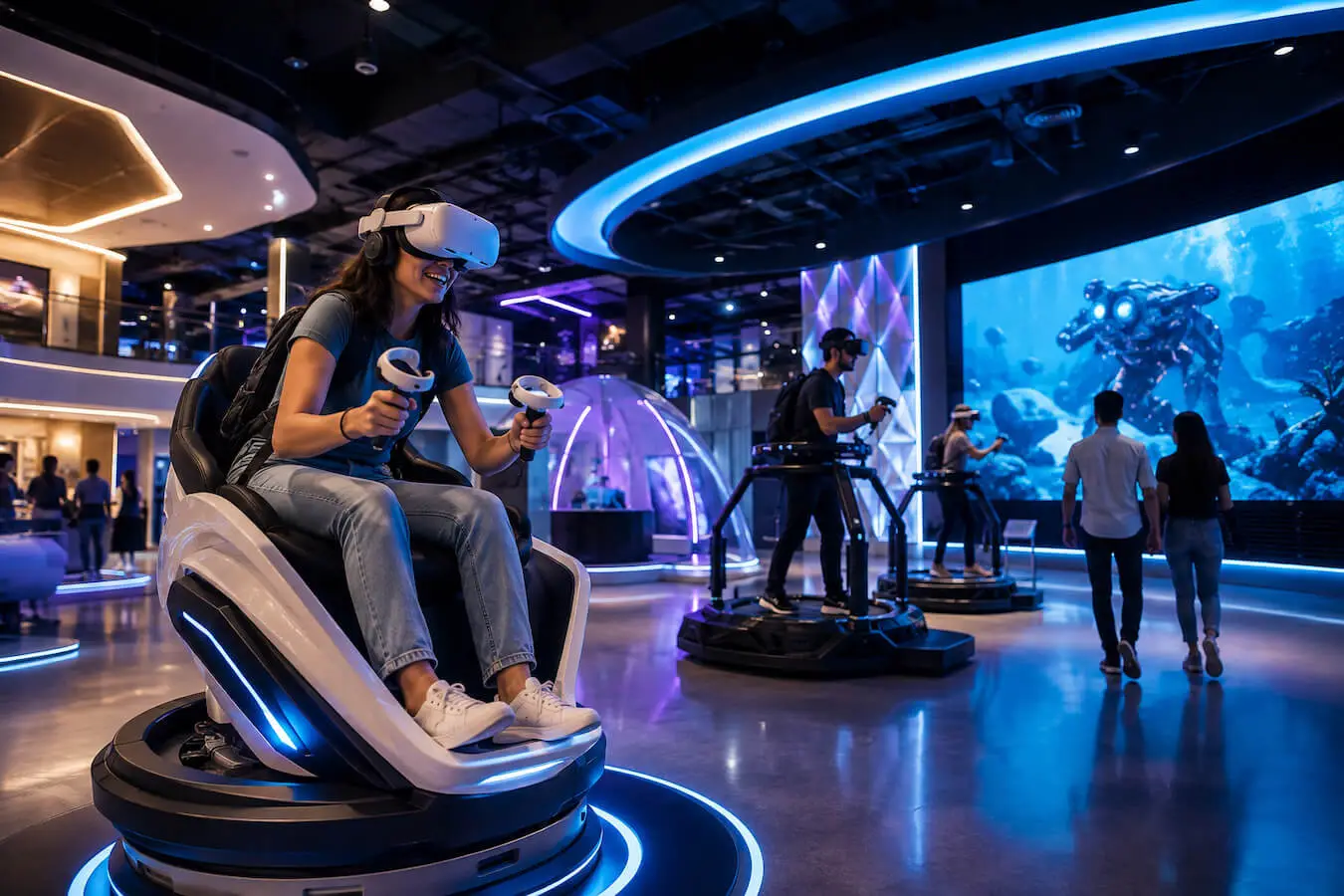
Table of Contents
What Is a Virtual Reality Park?
At its core, a virtual reality park is an entertainment venue or dedicated zone designed around fully immersive VR experiences. Guests suit up with headsets and interact with virtual worlds through motion platforms, handheld controllers, body tracking, haptic feedback, or free-roam multiplayer environments.
Some VR parks exist as standalone venues, while others operate as high-traffic zones inside larger theme parks, resorts, shopping centers, or museums. Depending on the scale, a VR amusement park layout typically includes:
- Motion simulator rides and 360-degree flying theaters
- Free-roam multiplayer arenas
- VR racing pods and interactive shooting adventures
- Virtual reality roller coaster overlays and immersive ride concepts on physical tracks
- Mixed reality (MR) attractions that blend physical sets with digital content
- Educational or branded immersive experiences
While the lines between a simple VR arcade and a full VR park can sometimes blur, the difference comes down to scale and storytelling. A small arcade usually offers individual, standalone stations. A true VR park integrates diverse attraction types, high throughput capacity, immersive theming, and a complete, well-orchestrated guest journey.
Why VR Is Redefining Location-Based Entertainment
Traditional park attractions are inherently constrained by the physical world. Track lengths, footprint limits, physical set construction, weather, and safety maintenance dictate everything a ride can do. VR completely flips that equation.
A compact motion simulator can run three entirely different storylines in a single day. A physical roller coaster can keep its exact track geometry while offering riders a completely new visual narrative every season. A free-roam arena lets groups walk through an alien base or a medieval dungeon without changing a single wall in the physical facility.
This shift directly meets modern guest expectations. Today’s audiences are used to interactive, highly visual media at home. When they visit an entertainment venue, they expect experiences that feel participatory rather than passive. Guests don’t just want to watch a world move around them; they want to be inside it, influencing what happens next.
The Sensory Stack Behind an Immersive VR Park
A world-class VR attraction is never just about the headset. Real immersion happens when multiple sensory systems align perfectly.
Visual Immersion
High-resolution displays, wide fields of view, fast refresh rates, and sub-millimeter tracking allow guests to forget the physical room around them. But visuals are only half the battle. If the body doesn’t feel what the eyes see, the illusion breaks.
Motion and Physical Feedback
Motion platforms, tilting seats, directional vibration, and synchronized ride vehicles connect visual movement with physical force. This is vital for a virtual reality roller coaster, where physical G-forces and visual motion must match perfectly to prevent discomfort.
Spatial Audio
Directional 3D audio gives virtual environments depth. Hearing a creature snarl directly behind you or a jet engine pass overhead pulls guests deeper into the experience, which is especially critical in multiplayer settings.
Haptics and Environmental Effects
Haptic vests, seat rumbles, targeted air blasts, heat, scent, and floor vibrations deliver tangible cues. When timed precisely, these environmental effects bridge the gap between “watching VR” and actually living the ride.
Free-Roam Tracking and Social Play
Free-roam VR allows guests to walk untethered through a physical space while exploring a vast digital realm together. Because theme parks are inherently social destinations, free-roam arenas turn VR into a shared group memory, allowing friends to cooperate, compete, and react together in real time.
How VR Elevates Traditional Park Attractions
VR does not elevate an attraction just by making it “more futuristic.” It works when the technology solves a real creative or operational problem.
Refreshes Aging Rides Efficiently
Rebuilding a mechanically sound dark ride or coaster can be cost-prohibitive. VR allows operators to keep the existing mechanical infrastructure while overlaying a fresh, modern story layer, dramatically shortening project timelines and reducing capital expenditure.
Multiplies Footprint Utility
Physical set construction is static. Digital environments are dynamic. A single VR footprint can host family-friendly content by day, horror-themed experiences during autumn events, and competitive multiplayer tournaments at night.
Adds Context to Physical Thrills
A traditional coaster provides speed, drops, and forces. VR adds narrative context. A sudden drop isn’t just gravity anymore. It’s an escape from a collapsing mine or a plunge into an ocean trench.
A study from the University of Southern Mississippi analyzing 178 theme park attractions noted that rides incorporating virtual content consistently generated higher wait times, signaling strong guest curiosity and demand for digitally enhanced experiences.
Creates Shared Group Experiences
Free-roam arenas, team missions, racing pods, multiplayer shooters, and escape-room-style VR experiences work because they create stories guests can retell afterward. “We beat the zombies” is more memorable than “I watched a nice 360 video.” That shared memory is what many operators are really selling.
Key VR Formats Operators Can Deploy
Depending on available space, target demographics, and throughput requirements, venues can choose from several proven formats:
- Free-Roam VR Arenas: Ideal for group bookings, parties, and corporate events.
- Motion Simulator Rides: Highly practical for venues needing predictable capacity planning. Multi-seat simulators are easier to staff and reset, delivering high-throughput space or underwater adventures within a compact footprint.
- VR Roller Coaster Overlays: Combines genuine physical G-forces with digital worlds. The key to success here lies entirely in operational efficiency during guest loading and headset fitting.
- Branded IP & Themed Zones: VR allows venues to drop guests into complex fantasy kingdoms or sci-fi worlds that would be cost-prohibitive to construct physically. Immersive design and engineering become critical, because the attraction has to balance storytelling, architecture, guest flow, and technical systems.
- Edutainment & Family Attractions: Museums, aquariums, and science centers use gentler VR formats for space exploration, deep-sea dives, and historical walk-throughs.
Operational Realities: What Operators Must Plan For
The technology is impressive, but long-term success is determined by operational discipline.
Throughput and Cycle Times
A 10-minute experience can easily stretch into a 20-minute operational nightmare if onboarding is clunky. Operators must design a seamless cycle: ticket scanning, quick briefing, headset adjustment, gameplay, offboarding, and rapid equipment sanitization.
Hygiene and Equipment Care
Guest confidence relies heavily on visible cleanliness. Having dedicated cleaning protocols, medical-grade UV-C sanitization, modular wipeable face covers, and organized charging stations is non-negotiable.
Motion Comfort
VR motion sickness occurs when visual motion doesn’t align with inner-ear feedback. While early theme park experiments in the late 1990s faced hardware limitations, modern systems mitigate discomfort through high refresh rates, sub-millimeter tracking, and carefully calibrated physical motion cues.
Staff Training and Maintenance
Staff need to be more than button-pushers. They must be trained to fit equipment quickly, troubleshoot network or tracking issues, assist nervous users, and maintain steady queue flow. For that reason, operators should think beyond the attraction launch. Ongoing development and operations planning helps protect uptime, guest satisfaction, safety, and repeat visitation after the initial installation is complete.
The Economics of Virtual Reality Attractions
When executed correctly, VR attractions offer distinct financial advantages over traditional build-outs:
- High Space Efficiency: VR delivers big-park thrills inside footprints suitable for malls, cruise ships, and family entertainment centers.
- Rapid Content Rotation: Updating digital software is significantly faster and cheaper than physical re-theming, driving higher repeat visits from local audiences.
- Premium Upsell Opportunities: Shared free-roam missions and VIP VR experiences command higher ticket prices and fit naturally into party or corporate packages.
For investors and operators, the smartest VR projects are not treated as one-off technology purchases. They are planned as complete entertainment assets, from concept and procurement to installation, staffing, safety, and guest experience. A structured turnkey attraction process can help connect those moving parts before the venue opens.
What’s Next for VR Parks?
The future of location-based VR lies in erasing the friction between the physical and digital worlds:
- Mixed Reality Onboarding: Using pass-through cameras, guests can see the real room, staff, and physical obstacles before transitioning seamlessly into full VR.
- AI-Driven Personalization: AI systems will soon adapt difficulty levels, narrative pacing, and languages in real time based on guest interactions.
- Advanced Haptics and Tracking: Full-body tracking and natural hand-gesture recognition are reducing reliance on heavy controllers, making interaction feel completely natural.
Is a VR Park Right for Your Venue?
A virtual reality park is an exceptional fit if you want to deliver high-thrill, highly repeatable entertainment within a flexible physical footprint. It is ideal for venues looking to boost group bookings, introduce seasonal content, or monetize underutilized space.
However, success requires commitment. If a venue cannot support steady maintenance, proper sanitization, and well-trained staff, the guest experience will suffer. The most successful projects always start with operational planning rather than hardware selection.
Final thoughts
Virtual reality parks give operators what traditional construction struggles to deliver: flexible worlds, interactive narratives, and high repeatability inside a controlled footprint. When you combine strong content with efficient queue management and sharp operations, a VR attraction becomes much more than a secondary feature – it becomes the primary reason guests walk through your doors.
Want to build or upgrade a VR attraction?
Partner with our team to map out your layout, guest flow, hardware selection, and operational strategy.
FAQ
What is the difference between a VR park and a VR arcade?
A VR arcade usually focuses on individual or small-group game stations, while a VR park is typically a larger, more themed attraction environment with multiple immersive experiences. A VR park may include simulators, free-roam arenas, VR roller coaster content, motion rides, branded experiences, and group attractions.
Are virtual reality roller coasters safe?
Virtual reality roller coasters can be safe when the headset system, ride synchronization, guest restraints, cleaning process, and operating procedures are properly designed. The biggest practical concerns are comfort, motion sickness, secure headset fitting, and smooth loading. Operators should work with experienced attraction designers and follow all ride safety requirements.
How much space does a VR attraction need?
The space depends on the format. A compact simulator may need only a small footprint, while a free-roam VR arena may require a much larger tracked area plus briefing, equipment, queue, and cleaning zones. Operators should plan for the full guest journey, not just the play area.
Can VR be added to an existing amusement ride?
Yes, VR can be added to some existing rides, especially roller coasters, motion platforms, simulators, and dark rides. The key is synchronization. The digital content must match the physical motion closely, and the operations team must be able to load, clean, and reset headsets without damaging throughput.
What makes a VR amusement park profitable?
A VR amusement park is more likely to be profitable when it combines strong content, reliable equipment, high uptime, efficient guest flow, clear pricing, group bookings, and regular content refreshes. The attraction has to work as an operation, not just as a technology demo.