
Key Principles When You Design a Water Park
Designing a waterpark may seem like a very fun thing to do. Fun, colorful slides, sparkling blue water, palm trees, etc. However, the actual designing involves quite a few factors. Flow, safety, and psychology all need to be considered before building the waterpark. Renderings are the easiest parts of the design, but the complexity comes from making the waterpark functional at peak hours. Imagine a Saturday at 2 PM with blistering heat. Everyone wants the same slides, the same food, and the same shaded chairs.
In my opinion, and from my experience, waterpark designs usually fail for a few different reasons. They fail to incorporate enough staff and enough space to accommodate the number of guests. Guest experience design from amusement parks is needed here. Lines and queues will form, and guests will always take the path of least resistance. This means that guests will always take the easiest path with the least amount of friction.
These are the principles that need to be considered and debated before anything else is done.
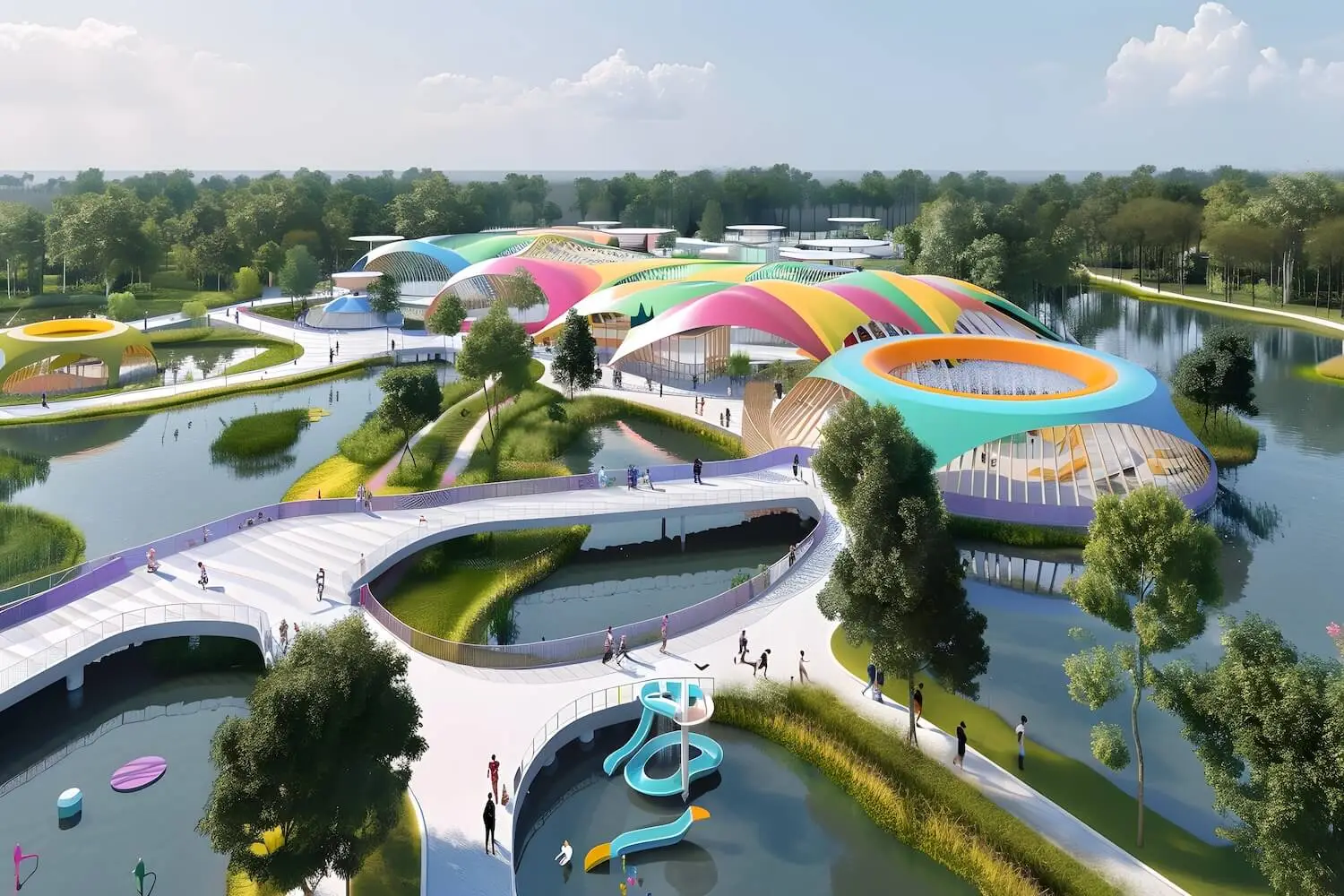
Table of Contents
1. Start with the “Guest Day,” Not the Slide List
Most design projects start with a wish list. We need a big drop slide, a family raft ride, and a wave pool, etc. This can be a great start, but a better way to start is to ask a different question. What does a guest’s day look like, hour by hour?
Instead of seeing a list of slides, and. Attractions, guests will experience the park in a sequence.
- Arrival: Parking and ticketing (the first impression).
- The Setup: Lockers and changing rooms (high chaos potential).
- The Decision: “Where do we go first?” (the first stress point).
- The Midday: Queues, heat, and hungry kids.
- The Departure: The “last hour” when energy drops, but gift shop purchases spike.
The Takeaway: Design the sequence, from arrival to the first splash, as deliberately as you design the thrill elements.
2. Make Your “Main Spine” Ridiculously Obvious
The most important feature of a successful water park is the main pathway, or loop, that guests will instinctively follow. If these paths are not clear, guests will feel uncertain.
There are several main features that help the guests feel most comfortable:
- Clear Sightlines: There should be minimal disruptions along the path that partially obscure you from seeing where you are headed.
- Visual Anchors: Significant structures or towers, themed entrances or icing slides, will help guests.
- Landmarks: Structures that help orient guests.
- Logical Connections: Create pathways that allow guests to easily access the family, fun, relax, and splash zones.
In amusement park design, guests love a simple mental map. Decision points, or multiple pathways diverging from one spot, disrupt the natural flow of guests.
3. Zone by Intensity
A good amusement park features “pacing,” or pathways and structures organized into zones.
These should include:
- Kids/Splash: Low intensity, high supervision zones.
- Family: Zones for shared experiences and moderate thrills together.
- Thrill: High-intensity slides for teens and thrill-seekers.
- Relaxation: Lazy rivers and cabana zones.
Practical transition moves:
- Use “buffer attractions” (smaller slides, play features) between extremes
- Put loudspeaker zones away from relaxation pools
- Create separate, obvious routes for strollers and for groups of teens
In amusement park design, this is called “guest energy management.”
4. Design for Throughput
The design of a water park becomes a numbers game; no matter how incredible a park may look, if it cannot process a sufficient number of guests every hour, it will undoubtedly underperform. Therefore, there are two main design considerations when designing a water park.
- Capacity: How many people can the park hold comfortably?
- Throughput: How many riders can an attraction handle per hour?
Having too many ‘slow loaders’ (rides that take a considerable amount of time to load and dispatch) will result in queueing conditions that negatively impact the overall experience of guests in the park. Guests will stop exploring the park, stop buying merchandise, and start complaining. Thus, guest experience optimization should always be a priority.
5. Put Shade Where the Queues Actually Are
Comfort is an operational requirement of the water park. Guides cannot wish guests to not to queue at certain water rides (the big attractions at the park), lockers, or food vendors. If the only shaded areas of the park are the walkways and not the queueing areas, guests will face unpleasant conditions. Complaints will result in guests leaving the park sooner.
Pro Tip: Guests are more forgiving if they are not dehydrated, so provide water refill stations along the longest lines.
6. Safety Baked into the Layout
The safety of your facility does not come from high-quality lifeguards but rather from the ease of the job lifeguards face because of your design choices.
- Sightlines: Design choices such as columns or lifts to not block views and sightlines from lifeguards.
- Design Staff Circulation: Staff circulation needs to be planned so they don’t have to push through guests during an evacuation.
- The Ship Story: A themed ship in a children’s area at a waterpark blocked views to the water, and the facility had to hire more lifeguards to help see over the ship. In time, they ended up lowering the ship, and they balanced safety and cost.
If lifeguards have constant sightlines that require them to reposition to see around structures, you are compromising safety.
7. Wayfinding Should Be Effortless
When guests are wet, barefoot, managing kids, and carrying towels, they have less patience for navigation puzzles.
Good wayfinding is a mix of:
- Don’t rely on map boards: People rarely stop to read them.
- Use visual cues: Color-code your zones (e.g., Blue for Kids, Red for Thrills).
- Signage at decision points: At turning points, aisles, serrated roads, or paths that split, signage should be present at that point. Not 20 feet before.
Amusement parks really encapsulate the philosophy of no stopping. No navigation challenges. It must always be evident what the next step is.
8. Put Revenue in the Flow
Many designers find this difficult to accept, but here’s the reality: the park will need to generate revenue. The nice thing about this, however, is that it doesn’t have to be done in an inauthentic way.
Revenue works best when it aligns with natural behavior:
- Food: Place it where people regroup (near shade or major exits).
- Retail: Place it near “dry” moments like the entrance or exit.
- Cabanas: Place them where they feel premium but are still convenient to the action.
Food kiosks are often misplaced in quiet areas because it looks nicer in the layout. As a result, they underperform because guests can’t find them.
9. Don’t Ignore “Back of House”
Great water park layouts are secretly obsessed with what guests don’t see:
- Maintenance access to pumps and filtration
- Chemical storage with proper separation and safety controls
- Waste handling routes
- Staff break areas (yes, it matters)
- Deliveries that don’t cross peak guest paths
Outdated and costly operational systems often lead to staff shortages, reduced maintenance, and increased guest dissatisfaction.
Generally, the “back of house” areas are what separate a well-maintained park from a tired and run-down facility, and that’s why facility management is so important.
10. Opening, Lunch, and Closing: Design for the Peaks
Peak moments define impressions. The park can run smoothly for hours, then collapse at lunch because the layout forces everyone through the same bottleneck.
Look hard at these moments:
Opening rush
- Can the entry process absorb surges?
- Are lockers and changing areas sized and placed for flow?
- Is there an obvious “first attraction” pull to distribute crowds?
Lunch surge
- Are food venues distributed or clustered intelligently?
- Can guests sit comfortably without hijacking pathways?
- Are refill points and toilets nearby?
Closing wave
- Can exits handle crowds safely?
- Is retail placed so it doesn’t jam the gate?
- Do locker areas become a choke point?
This is practical waterpark design work. Not glamorous. It’s where guest satisfaction is won or lost.
11. Build for the Future
When trends shift, so do popular attractions, and so do attendance patterns. Even your most popular attraction can shift outside your expectations.
So leave room for:
- Future expansion pads (with utilities planned)
- Reconfigurable queue areas
- Modular F&B kiosks
- Seating that can scale up during peak season
This is the approach within amusement park design, and the same principle is valuable here, too. Parks that can change and grow tend to remain relevant for longer periods.
A Quick Checklist Before You Finalize a Layout
If I’m reviewing a concept plan, I’m asking:
- Can a first-time guest understand the park in 30 seconds?
- Does the main spine feel obvious, comfortable, and shaded enough?
- Are thrill, family, kids, and relaxation zones clearly separated, but connected?
- Do headliners have queue comfort and overflow space?
- Are workhorses positioned to spread guests across the site?
- Are safety sightlines clean where supervision matters?
- Are F&B and premium seating located where guests naturally pause?
- Can staff move efficiently without battling crowds?
- Do opening/lunch/closing scenarios work without chaos?
If too many answers are “kind of,” that layout isn’t done yet.
In conclusion, designing a water park is about designing for human behavior in swimsuits, which is a challenging task. People get tired, hungry, distracted, and sometimes a little obstinate. The best water park design, therefore, is forgiving. It guides and absorbs surges and remains comfortable when the park is busy.
Contact Us to get the flow right, to get the comfort right and then to make it beautiful.