
What Is an Immersive Experience? The Design Ingredients Behind Immersive Attractions
An immersive experience is a physical, digital, or hybrid environment intentionally constructed to make people feel as though they have stepped inside another reality. By orchestrating spatial planning, multisensory design, narrative architecture, and interactive elements, these environments generate an authentic sensation of presence, transporting visitors from passive spectatorship into active habitation.
Picture entering a deep-sea research station. As you traverse the corridors, atmospheric lighting cools and dims, low-frequency mechanical hums pulse through the bulkheads, and an interactive instrumentation console reveals tactical clues about the waters outside. Every material detail reinforces the conviction that you are somewhere entirely removed from everyday life.
That emotional and psychological shift is the benchmark of world-class attraction design. Yet creating a compelling sense of transport requires far more than cutting-edge hardware or high-resolution imagery. It relies on a synchronized balance of foundational design ingredients working together as a single ecosystem.
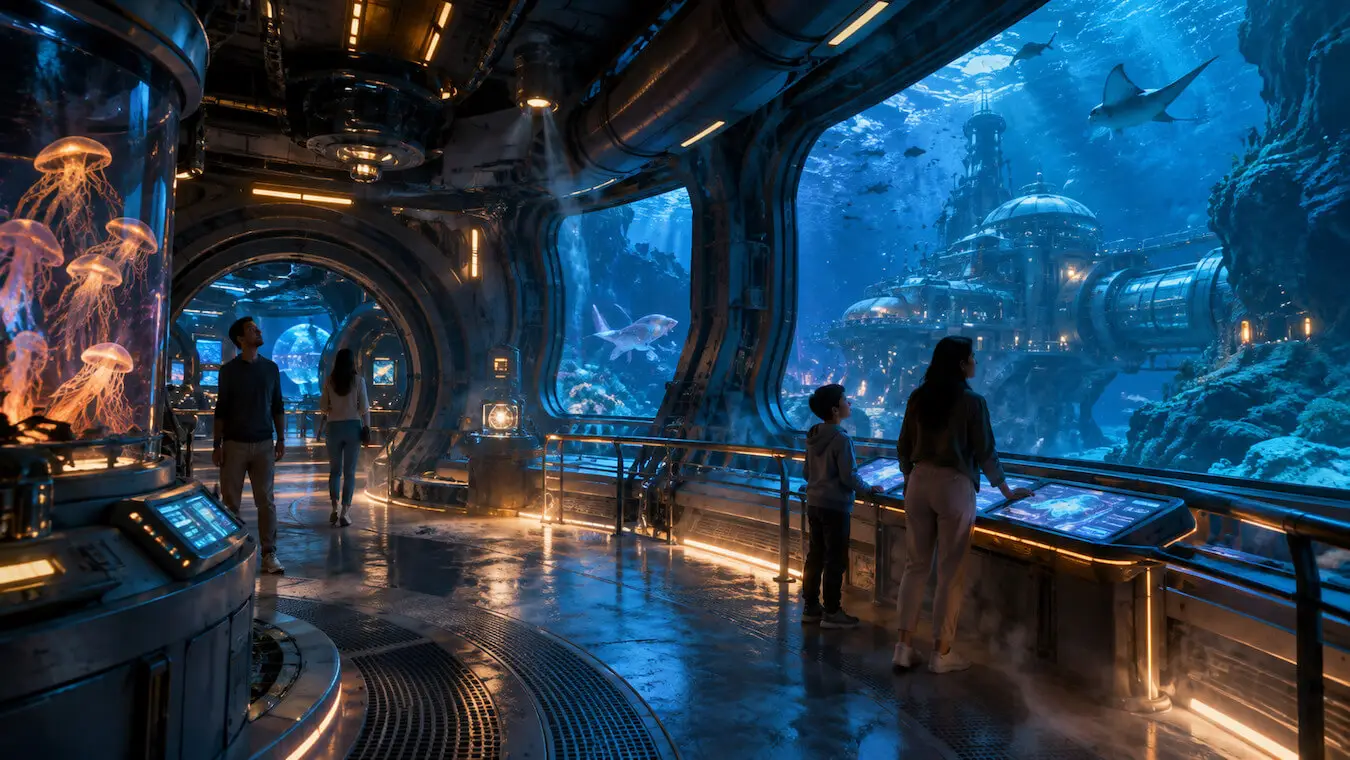
Table of Contents
What Makes an Experience Truly Immersive?
At its core, true immersion is defined by the psychological sensation of existing within an environment rather than merely viewing it from the perimeter. These environments can be physical, digital, or hybrid. What unites them is their ability to cultivate a convincing feeling of geographical and contextual belonging, inviting the guest to interact directly with the world around them.
The distinction becomes evident when comparing interpretive formats:
- The Traditional Exhibition: Presents subjects through vitrines, framed artifacts, wall texts, and video monitors, asking visitors to observe history or science through a physical barrier.
- The Immersive Exhibition: Transforms the architecture itself into the subject. The walls, floors, acoustics, and air become the narrative, allowing visitors to decode the experience through exploration, movement, and atmospheric discovery.
In museums and cultural experiences, for example, that shift allows the setting itself to help communicate historical or cultural context. Immersion does not inherently demand virtual reality headsets, capacitive touchscreens, or elaborate special effects. A purely physical environment can be profoundly absorbing when its architectural forms, material textures, and thematic narrative speak the same language.
Successful immersion may include deep sensory engagement, active participation, distinct and evocative settings, coherent storytelling, and an overarching sense of personal transformation. For destination planners and experience designers, the central objective is weaving these disparate threads into a frictionless visitor journey.
The Essential Design Ingredients Behind Immersive Attractions
The most memorable attractions rarely hinge on a single technological marvel. Their staying power stems from the calibrated synergy between space, sensory stimuli, story, operational rhythm, and human behavior.
Six foundational ingredients drive this dynamic.
1. Environmental Storytelling: Building a Believable World
Environmental storytelling relies on the physical setting to communicate lore, mood, and plot without depending on blocks of explanatory text, voiceovers, or instructional videos. Architecture, material aging, decorative props, lighting angles, and spatial volume collectively inform visitors of who inhabited the space, what occurred there, and what is at stake.
In an abandoned orbital research outpost, for instance, you do not need an orientation placard to establish tension. Scratched control consoles, pulsing emergency strobes, scattered field logs, and an airlock door sealed halfway shut instantly establish a mystery before a single word is spoken. These textured nuances make a set feel lived-in and authentic rather than newly assembled.
Consistency is non-negotiable. A meticulously realized historical or sci-fi world instantly shatters if an unpainted operational egress door or an exposed commercial electrical conduit intrudes upon the scene. This is why themed architectural design, scenic fabrication, and technical engineering must be integrated during the earliest schematic phases. The physical world must be robust and cohesive enough to withstand organic, unguided exploration. The same consistency matters in themed resorts.
2. Sensory Design: Layering Light, Sound, Texture, and Atmosphere
Humans perceive spatial reality through a multisensory filter. An attraction that caters exclusively to the eyes will inevitably feel artificial and two-dimensional.
- Lighting: Directs optical focus, conceals operational boundaries, and establishes emotional tone—from warm, intimate discovery to cold, foreboding tension.
- Spatial Audio: Directional sound systems provide spatial depth, hinting at off-stage activity, distant wildlife, or unseen mechanical systems operating beyond the perimeter.
- Tactile Materials: Physical touch—rough-hewn masonry, damp cavern stone, oxidized steel, or velvety drapery—grounds the body in the immediate reality of the space.
- Atmospheric Effects: Carefully managed temperature drops, localized humidity, subtle breezes, and scents reinforce the physical setting.
In water parks, moving water, ambient sound, temperature shifts, and humidity can become part of that sensory narrative rather than simply features of the venue. Crucially, sensory design requires restraint. Saturating an environment with competing audio tracks, blinding strobe patterns, and aggressive scents causes sensory fatigue rather than wonder. Designers must balance dramatic spectacle with contemplative negative space, while providing thoughtful accommodations for neurodivergent guests or visitors with sensory processing sensitivities.
3. Participant Agency: Giving Visitors a Meaningful Role
Immersion deepens exponentially when visitors possess agency, the perception that their choices, movements, or actions create tangible ripples in the world around them. Participant agency can take multiple forms, including branching pathways, hidden architectural discoveries, tactile puzzles, or optional layers of lore.
Imagine an ancient subterranean excavation site where guests discover cryptic glyphs etched across stone walls. Visitors who actively manipulate rotating stone seals might reveal hidden passages or illuminate forgotten chambers, unlocking deeper historical narratives. Simultaneously, guests who prefer to simply stroll through the atmospheric chambers can do so without feeling obligated to complete a game. Both archetypes experience a successful, valid immersion.
The critical factor is that interaction must feel native to the setting. An arbitrary touchscreen mounted to a stone wall breaks the illusion; a heavy mechanical iron lever that opens an ancient water valve reinforces it.
Furthermore, designers must continuously balance agency against operational throughput. An intricate interactive terminal that requires three minutes per person will inevitably generate logistical choke points and guest frustration if placed along a high-volume transit corridor.
4. Spatial Flow and Pacing: Shaping the Visitor Journey
An immersive attraction is fundamentally temporal architecture; it unfolds over time. How visitors move through space directly dictates how they absorb the story.
- Spatial Flow: Governs ingress points, primary circulation spines, discovery nodes, and egress transitions.
- Pacing: Governs the dramatic rhythm of the encounter—modulating tension, discovery, awe, and decompression.
A masterfully paced journey typically opens with an orienting decompression threshold, winds through increasingly detailed and intimate narrative environments, and culminates in an expansive, dramatic spatial reveal.
The transitional corridors connecting these spaces are just as vital as the hero show-scenes. A narrow, dimly lit corridor naturally builds psychological anticipation; a high-ceilinged atrium offers an emotional release after an intense sensory sequence. Sightlines must be calculated to tease iconic visual anchors in the distance, drawing guests naturally forward without the need for jarring operational signage.
Spatial planning must also satisfy operational realities. If an interactive feature halts foot traffic directly in front of an egress threshold, the entire room grinds to a halt. Guest preparation, queue ergonomics, holding capacity, and circulation must be engineered as an interconnected unit to preserve the narrative illusion during peak operating hours. These constraints should inform construction and planning from the outset, rather than being addressed after the attraction is built.
5. Technology Integration: Choosing Tools That Serve the Story
Modern immersive venues harness a broad technological palette: projection mapping, beam-tracking spatial audio, optical motion sensors, interactive DMX lighting, AR, and VR.
These digital frameworks dramatically expand the physical canvas:
- Projection Mapping: Dynamically alters static surfaces, turning solid stone facades into crumbling ruins or living ecosystems.
- Motion Sensors: Allow spaces to react organically to pedestrian proximity and movement without physical controllers.
- Augmented Reality: Overlays speculative reconstructions or animated historical layers over physical ruins and artifacts.
However, the technology must always remain subordinate to the emotional intent. Projection mapping excels at painting massive atmospheric vistas; tactile scenic fabrication excels when visitors need to physically touch and lean against their environment.
Engineers must also plan for operational maintenance, component longevity, thermal ventilation, and graceful system degradation. This is where development and operations become important: maintenance routines and guest experience management help protect the experience long after opening day. If an elaborate digital installation fails and displays a desktop operating system or an error code, the immersive illusion is instantly shattered. The finest technology in an attraction is functionally invisible: guests marvel at the magical world, completely oblivious to the racks of servers driving it from behind the walls.
6. Onboarding and Accessibility: Helping Everyone Enter the Experience
Before guests can suspend their disbelief, they require cognitive clarity. Onboarding is the process of setting the experiential rules, contextual premise, and safety boundaries before the journey begins.
Whether achieved through an in-character actor, a briefing preshow, or intuitive environmental wayfinding, onboarding prepares visitors to explore without giving away the story’s surprises.
Accessibility must be baked into the foundational layout rather than retrofitted:
- Clear, level circulation pathways for wheelchair users and mobility devices.
- Legible, high-contrast, multi-format wayfinding.
- Tactile, varied-height interaction stations.
- Alternative sensory pathways for visitors who need to bypass intense flashing, percussive audio, or enclosed spaces.
As outlined in IAAPA’s accessibility resources, thoughtful universal design creates more welcoming and inclusive destinations. When guests feel fundamentally safe, physically accommodated, and clearly oriented, the cognitive friction vanishes, allowing them to engage with the world on an emotional level.
What Types of Immersive Experiences Exist?
Immersive design manifests across a diverse spectrum of creative formats, each tailored to distinct audiences, venues, and operational models:
- Physical and Themed Attractions: Permanently constructed environments—such as rides and attractions, theme park lands, heritage walk-throughs, and branded pavilions—built around fictional universes, historic epochs, or original narratives.
- Immersive Theatre: Freely navigable performance environments where live actors, ambient sets, and unscripted guest movements drive the progression of the narrative.
- Interactive Installations: Responsive sensory exhibits where guest gestures, footsteps, or vocal inputs directly modulate ambient lighting, procedural audio, or digital visual canvases.
- Digital and Hybrid Environments: Spatial experiences driven by virtual reality, mixed reality, projection domes, or synchronized media environments that envelope guests in shifting computer-generated worlds.
These core design mechanics apply universally across industries, from commercial family entertainment centers and science centers to animal parks and zoos, public aquariums, and civic museums. The technical palette remains consistent; what adapts is the story being told and the way visitors are invited to inhabit it.
Why Some Immersive Attractions Fall Flat
It is entirely possible to pour millions into cutting-edge technology and Hollywood-grade scenic fabrication, yet end up with an attraction that feels hollow, frustrating, or unconvincing.
The failure usually stems from friction points between individual design disciplines:
- Narrative Disconnect: An attraction boasts gorgeous scenery, but forces guests to stop and read confusing operational placards or decipher unintuitive interfaces.
- Irrelevant Interactivity: An interactive kiosk is inserted into a room simply for the sake of having a digital feature, adding physical clutter without enriching the narrative.
- Sensory Overdrive: Competing audio sources, relentless visual strobing, and unmodulated lighting create physical exhaustion rather than emotional transport.
- Operational Blind Spots: A haunting chamber engineered to evoke solitude when tested with four visitors becomes an uncomfortably loud, claustrophobic bottleneck when loaded with forty guests during a Saturday rush.
- Optical Distortions: Media projection calibrated solely for a flat, center-room perspective warps into an unconvincing smear when viewed from the perimeter walkways.
These breakdowns illustrate why immersive design cannot exist solely within 3D conceptual renderings. Worlds must be stress-tested against the unpredictable realities of human foot traffic, diverse group behaviors, and prolonged operational cycles.
How to Evaluate an Immersive Attraction: The 5-Point Design Audit
Determining whether an attraction functions as an immersive world requires auditing the total guest experience. During schematic reviews, physical prototyping, and operational soft-launches, ask these five diagnostic questions:
- Does the environment establish an internally consistent world? Do the architectural forms, environmental audio, materials, and lighting palettes support one cohesive narrative?
- Do visitors understand how to participate instinctively? Does the environment invite interaction through intuitive spatial cues, or does it require constant staff intervention and instructional text?
- Does the visitor journey have a deliberate dramatic rhythm? Are moments of high-energy interaction and visual wonder balanced with zones of quiet reflection, anticipation, and ease?
- Can diverse visitors engage comfortably and safely? Are physical accessibility, sensory accommodations, and variable engagement levels woven seamlessly into the layout?
- Does the experience hold up under peak operational capacity? Do interactive stations, transit corridors, and queue transitions operate smoothly when loaded with real-world crowd volumes?
Observing real guests inside full-scale prototypes consistently reveals unexpected blind spots: visitors may bypass a critical narrative trigger, linger in transit bottlenecks, or completely misread a key visual beacon. Identifying these behavioral quirks early allows design teams to refine layouts before concrete is poured.
For complex commercial ventures, integrating creative vision directly with architectural engineering and operational modeling is paramount. ICM’s turnkey development model is structured specifically around this principle, uniting master planning, aquatic and scenic engineering, construction logistics, and ongoing facility operations into one continuous discipline.
Turning Immersive Concepts Into Real Attractions
Understanding what an immersive experience is provides a starting point. Creating one that works for visitors requires a more coordinated approach. Storytelling, architecture, sensory design, interactive technology, and operational planning all influence the final result. When these disciplines are developed together, the attraction can deliver a coherent experience while remaining practical to build, maintain, and operate.
For developers and operators exploring new immersive destinations, early collaboration between creative and technical teams can help identify opportunities and constraints before major design decisions are finalized.
Designing an Immersive Attraction? Explore ICM’s Expertise
ICM brings together themed architectural design, ride and attraction concepts, immersive storytelling spaces, and technical engineering to develop entertainment environments that engage visitors.
From early concepts to detailed design, ICM works to connect creative ambition with the practical requirements of real-world attractions.
Explore our Design & Engineering Services and discover how your immersive attraction concept can take shape.