
Are Safaris Ethical? The Design Principles Behind Ethical Wildlife Parks
Safaris can be ethical, but only when they’re designed around wildlife welfare, conservation, and local community benefit. A safari becomes unethical when animals are chased, baited, touched, crowded, used for selfies, or treated as guaranteed entertainment rather than wild animals with their own space and behaviour.
A responsible safari should protect habitat, keep human contact low, pay and train guides properly, and create value for the people who live alongside wildlife. Done well, an ethical safari can help fund conservation and local livelihoods. Done badly, it becomes another form of wildlife exploitation with better scenery.
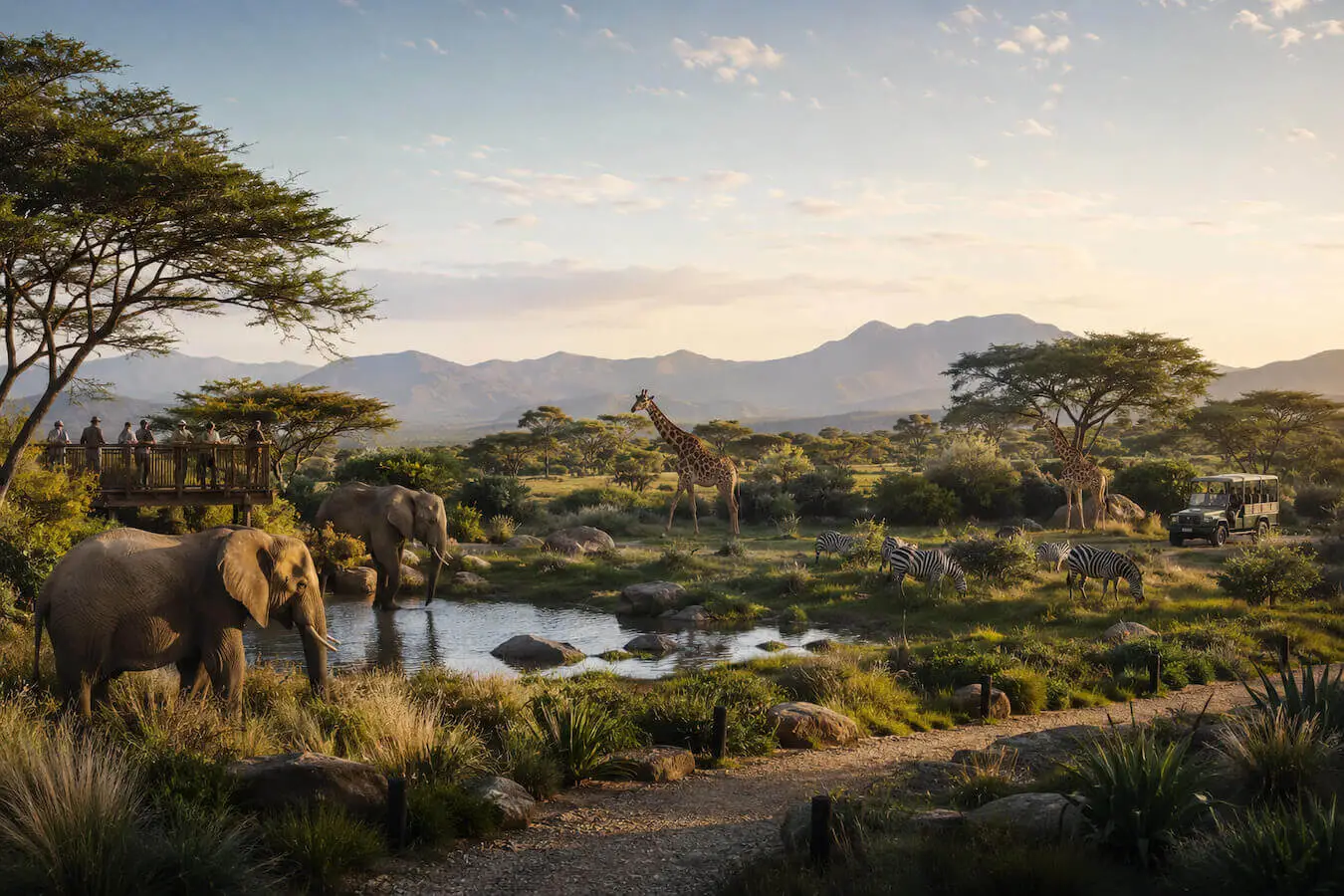
Table of Contents
What makes an ethical safari different from wildlife entertainment?
An ethical safari is based on observation, not interaction. That sounds simple, but it rules out a lot of tourist experiences that are marketed as “once in a lifetime.” Riding elephants, petting cubs, walking with captive predators, feeding wild animals, and taking close-contact selfies are not ethical safari experiences.
A proper safari works differently. You enter the animal’s environment with rules. You watch from a respectful distance. You accept that wildlife may appear, disappear, sleep, hide, hunt, fail to hunt, or do nothing dramatic at all. That last part is important. Ethical wildlife viewing does not guarantee a performance.
The best parks and operators don’t promise that you’ll see the Big Five before lunch. They don’t bait a leopard to a road or pressure guides to push closer because guests are disappointed. They design the experience so that the animal’s normal behaviour comes first and the visitor’s photo comes second.
The three levels of an ethical safari
Most people judge safaris at the animal level: was the lion stressed, was the elephant chased, were tourists allowed too close? That’s a good starting point, but it’s not enough. A safari can avoid obvious animal cruelty and still fall short if it damages habitat or excludes local communities from the benefits. A genuinely ethical safari works on three levels.
Animal welfare
Animal welfare starts with the habitat. The layout should support natural movement, resting, feeding, social behaviour, privacy, and enrichment. Animals should not be forced into constant display simply because guests expect visibility. Good safari design includes retreat areas, landscape variation, shade, water access, controlled viewing points, and barriers that protect without making the environment feel like a cage.
For a wider look at this balance, see our guide to modern zoo design and animal welfare.
Conservation
An ethical wildlife park should contribute to conservation education, habitat awareness, species protection, or responsible breeding and care programmes where appropriate. It should help visitors understand ecosystems. Responsible travel can also support endangered species protection and local livelihoods when tourism resources are reinvested into conservation and surrounding communities.
Guest experience
Guest experience still matters. Ethical does not mean dull. The challenge is to create immersion without intrusion. A well-designed safari gives visitors the feeling of entering a living environment while keeping clear operational boundaries behind the scenes. Storytelling, landscape design, viewing platforms, controlled routes, and digital interpretation can all deepen the experience without putting pressure on animals.
The design principles behind ethical wildlife parks
Ethical wildlife parks are not ethical because the brochure says “eco.” They’re ethical because the rules, incentives, land use, and money flows make responsible behaviour normal. Here are the design principles that matter.
Habitat-first masterplanning
The habitat should lead the design, not the guest path. Before roads, lodges, restaurants, viewing decks, or entertainment features are planned, the project team needs to understand the species, climate, terrain, vegetation, water systems, and operational requirements of the site.
This is where safari design differs from conventional attraction design. The “main character” is not the guest. It is the ecosystem being created. Visitors still need a memorable journey, but the route should be planned around animal welfare and site logic, not the other way around.
Construction that supports welfare, safety, and durability
Construction decisions can quietly strengthen or weaken the ethics of a safari park. The wrong materials, poor drainage, weak service routes, insufficient holding areas, or badly positioned barriers can create stress for animals and operational problems for staff. These issues may not be obvious to guests on opening day, but they affect how the park functions every day after that.
Construction and planning services should focus on turning entertainment concepts into fully realised destinations through construction coordination, structural engineering, large-scale installation planning, and project execution with attention to safety, precision, schedule, and operational standards.
For safari parks, this construction discipline matters because animal habitats are not static sets. They are living environments. Once the park opens, animals, guests, keepers, guides, vehicles, water systems, planting, weather, and maintenance teams all interact with the built environment every day. A design can look ethical on paper. Construction determines whether it actually works.
Low-impact guest movement
One of the biggest ethical risks in safari tourism is pressure at sightings. When too many vehicles gather around one animal, the experience becomes stressful and unnatural. Guides may edge closer. Guests may ask for better photos. Animals may be blocked, followed, or surrounded.
Ethical safari parks reduce this risk through design. That can include one-way routes, controlled vehicle numbers, alternative viewing points, wider pull-off areas, time limits at sightings, and landscape features that prevent vehicles from pushing too close. In pedestrian safari environments, it may include boardwalks, elevated hides, screened viewing zones, and carefully designed sightlines.
The goal is simple: guests should get meaningful views without controlling the animal’s behaviour. Good design removes the need for constant correction. Instead of relying only on guides to say “we can’t go closer,” the park layout itself creates respectful distance.
No-contact experience design
An ethical safari does not need touching, feeding, riding, or staged interaction to feel powerful. In fact, those features usually weaken the experience. They turn wildlife into a prop and teach guests the wrong lesson: that closeness equals connection.
Better experience design uses space, storytelling, sound, landscape, interpretation, and pacing. A guest can feel deeply connected to wildlife from a respectful distance if the environment is designed well. Augmented reality, live tracking, interpretive media, and educational storytelling can help visitors understand what they are seeing without needing to get closer, touch, or interfere. The best safari design makes restraint feel rewarding.
This is where design and engineering for immersive destinations becomes central: the guest experience can be memorable, emotional, and commercially strong without relying on direct animal contact.
Operations planned from the beginning
A safari park is not finished when construction ends. It becomes ethical through daily operations: animal care, habitat maintenance, guide training, guest management, veterinary access, feeding protocols, emergency planning, and conservation programming.
This is why operations should be part of the design process from day one. If the design team does not understand how keepers, guides, maintenance teams, and animal care specialists will use the space, the park may look impressive but operate poorly.
Development and operations services should include facility management, wildlife care and habitat operations, guest experience optimisation, and aquarium life support systems management, with a focus on efficient, safe, and engaging venue performance.
Most ethical failures are not dramatic one-off events. They are small operational compromises repeated over time. That is why the design-build-operate model is so valuable for wildlife destinations. It connects the original concept to the daily reality of running the park.
Are safaris more ethical than zoos?
Often, a well-run safari is more ethical than a traditional captive wildlife attraction because animals remain in their natural habitat and visitors observe natural behaviour from a distance. But that does not make every safari ethical, and it does not make every zoo identical.
Some zoos contribute to conservation, rescue, research, or breeding programmes. Some safari operations disturb animals or damage ecosystems. The better comparison is not “safari good, zoo bad.” It is whether the experience prioritises animal welfare, habitat, conservation value, and transparency.
As a simple rule, wild observation with no contact is usually stronger ethically than captive interaction for entertainment. But you still need to ask how the safari is managed.
How ethical safari parks balance immersion and protection
The most successful ethical safari environments do something difficult: they make guests feel close to nature while keeping the right distance from wildlife. That balance comes from careful design.
A bend in the road can reveal a habitat slowly. A raised deck can create a dramatic view without entering animal space. Planting can soften barriers. Water features can guide animal movement naturally. Digital interpretation can explain behaviour without requiring staff to stage it. Service routes can let care teams work efficiently without disrupting the visitor journey.
None of these choices happen by accident. They sit at the intersection of architecture, engineering, animal care, storytelling, and operations. That is why ethical safari development needs more than a beautiful concept image. It needs a team that understands how immersive destinations are designed, built, commissioned, and operated over time.
The role of sustainability in ethical safari construction
Ethical safari design also includes environmental responsibility. For safari parks and wildlife destinations, sustainability may include:
- Energy-efficient systems
- Water recycling and responsible drainage
- Waste reduction
- Low-impact lighting
- Native or climate-appropriate planting
- Responsible sourcing
- Durable construction materials
- Reduced single-use plastics
- Long-term maintenance planning
These decisions may not be the first thing guests notice. But they affect the park’s environmental footprint for years. A safari park should not teach respect for nature while wasting resources behind the scenes.
Final takeaway: ethical safaris are built into the project
So, are safaris ethical? They can be when ethics are built into the project from the beginning. An ethical safari is not created by adding conservation language to a brochure after construction. It comes from habitat-first masterplanning, careful construction, responsible guest flow, no-contact experience design, transparent operations, and long-term animal care.
For wildlife parks, animal parks, and safari destinations, the real work happens before the first guest arrives. It happens in the design drawings, construction planning, engineering systems, keeper access routes, guest pathways, landscape decisions, and operating procedures. That is what separates an ethical safari from wildlife entertainment.
The best safari parks do not ask animals to perform for people. They design the environment so people can observe, learn, and care, while animals continue behaving like animals.
Planning an animal park, safari, aquarium, or conservation-focused destination?
We help you bring immersive wildlife experiences from concept to operation through design, engineering, construction planning, and long-term venue development.