
How Technology Is Enhancing the Museum Experience
Technology is enhancing the museum experience by making exhibits more interactive, accessible, personalized, and easier to understand. Instead of asking visitors to only read labels and look through glass, museums can now use augmented reality, virtual tours, mobile guides, AI, projection mapping, and digital collections to add layers of context around the objects on display.
The best museum technology helps people notice more, ask better questions, and stay connected to the story after they leave. That distinction matters. A touchscreen placed beside an artifact is not automatically an improvement. A VR headset is not automatically immersive. The useful question is simpler: does this technology make the visit clearer, richer, or more welcoming?
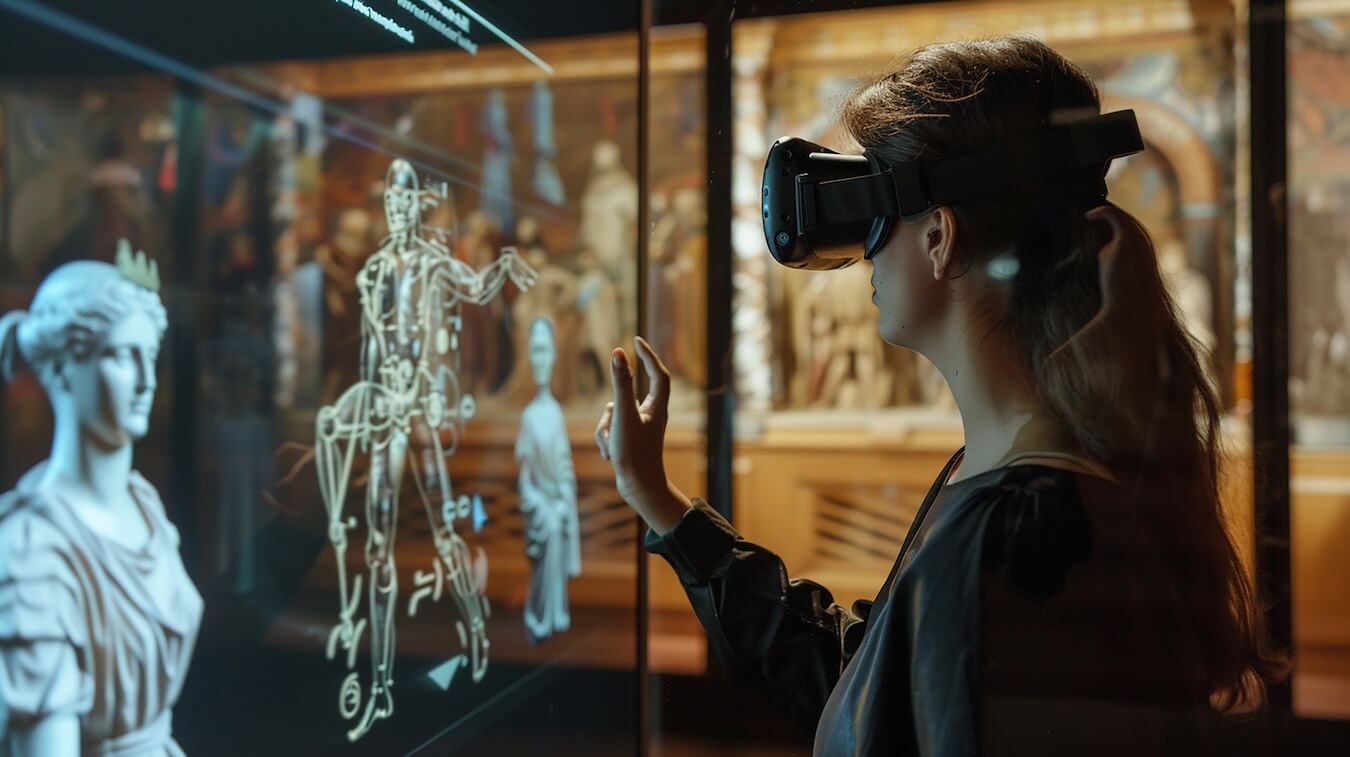
Table of Contents
Technology Changes the Visit – It Doesn’t Replace It
Museums have always relied on behind-the-scenes systems, from specialized lighting and climate controls to digital cataloging. What has shifted recently is how visible and interactive that technology has become for the visitor.
Today’s audiences are used to controlling how they consume information. They zoom, translate, save, and jump between sources. Modern exhibitions respond to this habit by offering multiple ways to engage with the same story, using tools like:
- Augmented Reality (AR): Overlaying digital reconstructions directly onto damaged or fragmentary artifacts.
- Virtual Reality (VR): Transporting visitors into delicate, remote, or historical environments.
- Smart Mobile Guides: Delivering personalized routes, multilingual audio, and deeper background detail.
- Projection Mapping & Spatial Audio: Transforming physical rooms into atmospheric, multi-sensory environments.
- Interactive Kiosks: Giving guests of all learning styles room to explore archival media at their own pace.
This is why interactive museum exhibits have become such an important part of modern cultural design. The physical object remains the hero of the space. Technology simply provides better doors to walk through.
Before Visiting: Removing Friction
A great museum visit begins long before someone enters the lobby. Digital ticketing, timed-entry passes, mobile maps, and online planning tools eliminate the practical headaches that ruin a morning out.
When a family can confirm accessibility details, a teacher can download learning guides, or a tourist can secure a spot in a crowded exhibition from their phone, they arrive relaxed and ready to engage.
Online collections also shift the visitor’s relationship with the institution. Browsing objects digitally beforehand builds familiarity, turning the physical encounter into a meaningful moment rather than a brief glance.
Mobile apps and digital platforms can also recommend routes based on time, interest, age, language, or accessibility needs. Someone with 45 minutes might get a tight highlights route. Someone interested in fashion, migration, or ancient technology might get a themed path through several rooms. The risk is over-personalization. Museums should not narrow the visitor’s world so much that they miss the surprise of wandering. The strongest digital planning tools guide without trapping.
For museums planning a larger transformation, this kind of pre-visit thinking should sit inside a broader museum and cultural experience strategy, not be treated as a separate digital add-on.
During the Visit: Making Exhibits More Interactive and Memorable
Inside the exhibition space, technology is at its best when it reveals details that are invisible to the naked eye, like the original paint on an ancient statue, the internal mechanics of a historic machine, or the hidden layers beneath a painting.
- Augmented Reality keeps guests anchored in the room. Pointing a phone or tablet at a display can trigger animations, translations, or historical context while keeping the visitor fully present in the gallery.
- Virtual Reality creates a sense of place. When a museum needs to show the sheer scale of an ancient city or the atmosphere of an artist’s studio, VR offers an immersive detour that a printed label simply cannot match.
- Projection and ambient sound shape the mood. Without requiring headsets, light and spatial audio can turn a static room into an ocean floor or a bustling historical marketplace, making the story feel alive.
- AI conversational guides answer questions in real time. AI-driven platforms can tailor responses to a guest’s specific curiosity, suggesting what to see next or explaining how an object was made.
The strongest exhibition spaces combine technology with spatial planning, lighting, sound, visitor flow, and storytelling. That is where design and engineering for immersive destinations becomes central to the experience.
Accessibility: Technology’s Most Powerful Impact
The strongest argument for digital tools in culture is inclusion. Technology gives museums new ways to welcome visitors who have traditionally faced physical, sensory, or linguistic barriers.
- Multilingual Digital Guides: Replace crowded wall text with instant translations in dozens of languages.
- Captions and Audio Descriptions: Give d/Deaf, hard-of-hearing, blind, and low-vision guests equal access to every story.
- 3D Scanning and Printing: Turns fragile, touch-prohibited artifacts into tactile learning models that guests can handle.
- Remote Digital Access: Allows students, researchers, and bedridden individuals to tour galleries and study collections from anywhere in the world.
Accessibility also works best when it is designed into the project from the beginning. In spaces such as a Children’s Museum, multi-sensory interaction, touch, movement, and play are not decorative extras. They are part of how different visitors learn.
After the Visit: Extending the Experience
A meaningful museum visit rarely ends at the gift shop. Visitors often leave with half-formed questions, a favorite artwork they want to share, or an interest in reading more.
Digital tools allow museums to nurture that curiosity. App features that let guests save their favorite objects, follow-up emails with custom reading lists, and digital classroom resources turn a one-hour visit into an ongoing relationship with the institution.
Behind the Scenes: Technology Improves the Museum Too
Visitors usually notice the screens, apps, and immersive rooms. They rarely see the systems behind them. But behind the scenes, technology can improve collection management, conservation, operations and planning.
3D scanning can document objects and spaces in detail. Digital twins can help teams plan exhibitions or preserve heritage sites. Analytics can show where visitors slow down, where they get lost, and where crowding becomes a problem. Digital ticketing and membership systems can help museums understand demand and communicate with audiences more effectively.
The best visitor-facing improvements often start here. If staff cannot update content easily, fix broken devices quickly, or understand how people move through the building, the visitor experience suffers.
That is why museum technology should connect with the full turnkey process, from concept and design to construction, technical integration, and long-term operation.
Avoiding Common Pitfalls: When Tech Gets in the Way
Technology fails the moment it creates a barrier between the guest and the exhibit. Dead batteries, complex interfaces, noisy rooms, broken touchscreens, and buggy apps frustrate visitors and drain staff resources.
- Respect Tech Fatigue: Not every visitor wants a screen in their face. A good museum design offers quiet, contemplative spaces alongside interactive zones.
- Protect Visitor Privacy: Personalization tools should use minimal data, operate transparently, and respect guest trust.
- Maintain Curatorial Integrity: Digital reconstructions are interpretations, not absolute facts. Museums should always make it clear where historical evidence ends, and creative interpretation begins.
A useful benchmark is whether the technology enhances the story rather than competing with it. Projects like the Cabinet of Curiosities Museum show how atmosphere, display design, lighting, and interactive storytelling can support the collection without overwhelming it.
How to Choose the Right Tool for the Job
Avoid starting with the device. Starting with “We need an AR app” usually leads to gimmickry. Instead, start with the visitor problem, then select the leanest tool to solve it:
- To reveal hidden context or missing pieces: Use AR overlays, short animations, or layered digital labels.
- To showcase inaccessible or lost environments: Deploy VR headsets, 360-degree video, or virtual tours.
- To serve multilingual or diverse audiences: Offer smart mobile guides, audio descriptions, captions, and screen-reader content.
- To make fragile or distant objects tactile: Utilize 3D scanning paired with high-detail 3D printing.
- To build atmosphere in a physical room: Apply projection mapping, ambient lighting, and directional spatial audio.
- To streamline venue operations: Implement digital ticketing, smart wayfinding, and real-time visitor analytics.
For larger venues, the decision also needs to account for staffing, maintenance, visitor flow, content updates, and revenue strategy. That is where development and operations planning becomes just as important as the creative concept.
The Future of Museum Experiences Will Be More Blended
The future museum will not be purely physical or purely digital. It will be blended. Visitors will move between objects, rooms, phones, projections, audio, digital collections, AI assistants, and human guides. Some experiences will be spectacular. Others will be almost invisible.
The most interesting work may happen where technology becomes quieter: a translation that appears at the right moment, a route that adapts to a visitor’s time, a tactile replica beside a fragile original, a digital archive that lets someone continue a story at home.
Emerging museum technologies are moving towards a future shaped by AI, VR, next-generation tours and personalized guides. But the real opportunity is not to make museums feel like tech demos. It is to make them feel more open, more memorable and more human.
For teams planning ahead, the shift is already visible in broader global museum trends, where sustainability, digital innovation, flexible public spaces, and hybrid experiences are becoming part of long-term cultural strategy.
Final Thought
Technology is enhancing the museum experience when it helps visitors connect more deeply with culture, history, science and art. It can make museums easier to navigate, more accessible, more interactive, and more relevant beyond the building. But the collection still has to lead. The story still has to matter. The technology earns its place only when the visitor leaves with something they might not have understood, felt, or remembered otherwise.
Planning a more interactive museum experience?
Contact us, and we will help you find the right solution for you.
FAQ
1. How has technology impacted museums?
Technology has made museums more interactive, accessible, and personalized. Visitors can now use mobile guides, AR, VR, online collections, digital maps, and interactive displays to explore exhibits in ways that match their interests, language, time, and accessibility needs.
2. What technology is used in museums?
Museums use technologies such as augmented reality, virtual reality, AI guides, mobile apps, digital kiosks, projection mapping, 3D scanning, 3D printing, online collections, digital ticketing, and visitor analytics. These tools support both the public experience and behind-the-scenes operations.
3. How does AR improve museum exhibits?
AR improves museum exhibits by adding digital layers to physical objects. It can show reconstructions, animations, translations, historical context, or conservation details while keeping the visitor connected to the real object in the gallery.
4. What is an example of immersive museum technology?
An example of immersive museum technology is a VR reconstruction that lets visitors explore a historical site as it may have looked in the past. Projection mapping, spatial audio, and multisensory rooms are also common immersive tools.
5. Can technology make museums more accessible?
Yes. Technology can make museums more accessible through multilingual guides, captions, transcripts, audio descriptions, screen-reader-friendly content, tactile 3D replicas, remote tours, and digital collections for people who cannot visit in person.
6. What are the disadvantages of using technology in museums?
The main disadvantages are cost, maintenance, privacy concerns, technical failures, visitor frustration, and the risk of distracting from the collection. Museums should use technology only when it improves understanding, access, or engagement.