
The Rise of Indoor Water Parks: A Comprehensive Look at All-Season Fun
An indoor water park turns swimming, slides, waves, and resort-style relaxation into a year-round experience. Rain, snow, heat waves, and cold winters matter less when the attractions sit inside a climate-controlled building.
That simple advantage has changed the water park business. What used to be a seasonal attraction is now a destination model, often connected to hotels, restaurants, arcades, spas, conference centers, and retail. Families get predictable fun. Operators get more stable attendance. Developers get a reason for guests to stay longer and spend more on-site.
However, the best indoor water park is not just an outdoor park with a roof over it. The real work happens in the design: airflow, humidity control, water treatment, roof height, guest movement, safety sightlines, ride mix, and the business model behind the building.
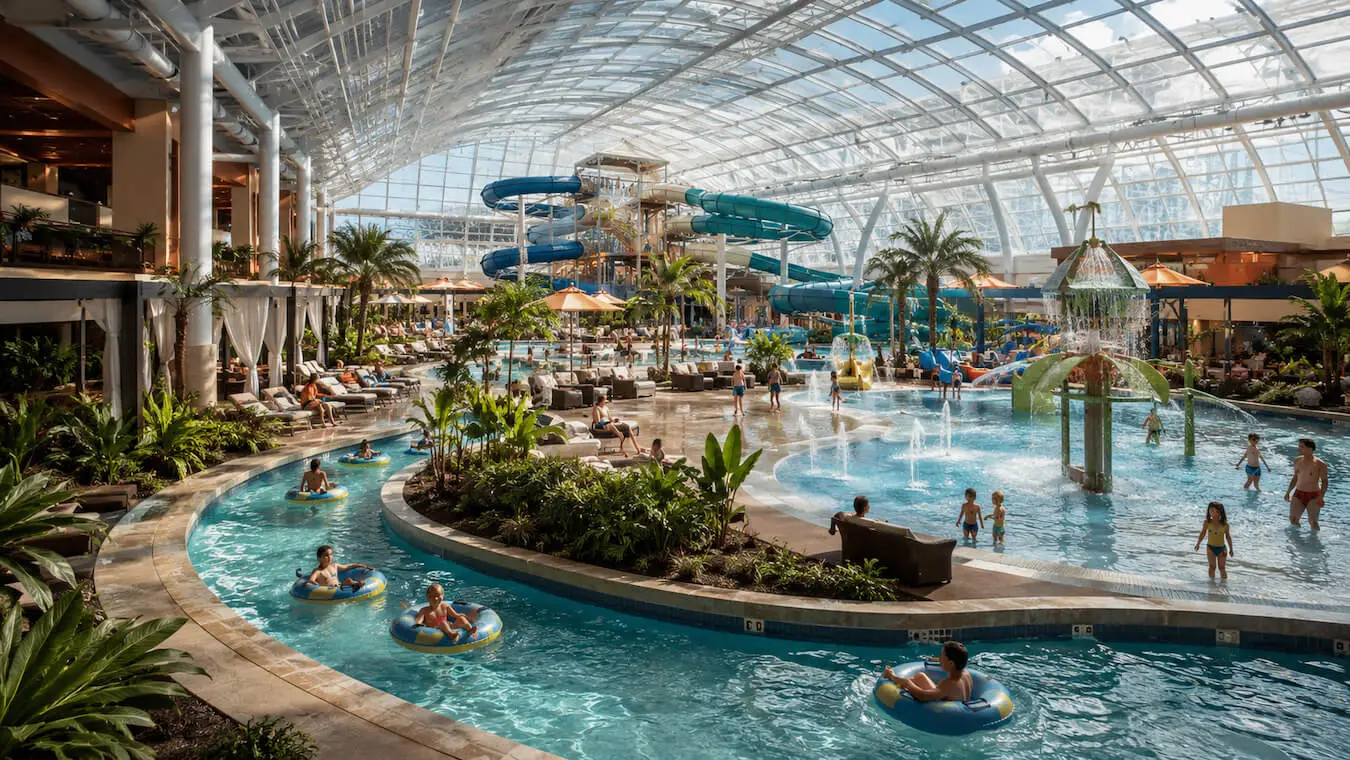
Table of Contents
What Is an Indoor Water Park?
An indoor water park is a climate-controlled aquatic entertainment facility built inside an enclosed structure. It usually includes a mix of water slides, splash zones, lazy rivers, wave and activity pools, cabanas, food and beverage areas, and family amenities. Some indoor parks are part of themed resorts. Others are attached to hotels, malls, casinos, municipal recreation centers, or mixed-use entertainment complexes.
The appeal is easy to understand. Guests can plan a trip without checking the weather every hour. Parents can promise their children a water park weekend in February. Operators can keep revenue moving outside the summer season.
Why Indoor Water Parks Became Year-Round Destinations
Outdoor water parks are powerful in warm-weather markets, but they have one obvious weakness: the calendar. In many regions, the season is short. Even in warmer climates, storms, high winds, extreme heat, and bad weather forecasts can cut into attendance.
Indoor water parks solve a different problem. They make aquatic entertainment more predictable. For guests, that means fewer ruined plans. For owners, it means a better foundation for hotel stays, group bookings, memberships, birthday parties, corporate retreats, and multi-day packages. Essentially, that predictability is often the whole point. That growth reflects a broader shift toward destination entertainment: places where the water park is the anchor, but not the only reason to visit.
The Design Behind a Successful Indoor Water Park
Good indoor water park designs start with the guest experience, but they only work if the technical systems support that experience every day.
Climate control and humidity
Most guests notice the temperature first. They want it warm enough to feel comfortable in swimwear, but not so warm that the building feels heavy or unpleasant. Operators have a harder job. They need to manage moisture, evaporation, air movement, chemical byproducts, and comfort across the entire park. Wave pools, splash features, tipping buckets, surf simulators, and aerated attractions all add moisture to the air.
Humidity caused by aeration can stick to walls, contribute to corrosion, and create challenges for HVAC systems. This is where inexperienced planning gets expensive. If the air-handling strategy is treated as a late engineering detail, the building may suffer from condensation, corrosion, poor guest comfort, or high energy costs. The HVAC plan should be part of the water park blueprint from the beginning.
Roof systems, light, and the building envelope
Indoor parks need volume. Tall slide towers, wave pools, lazy rivers, and large play structures do not fit comfortably inside a low box. That creates design trade-offs. A higher roof gives designers more freedom, but it increases building cost and air volume. Glass roofs and large windows create a brighter, more resort-like feeling, but they also affect heat gain, glare, condensation, and envelope performance.
Some newer concepts use retractable roofs or hybrid indoor-outdoor zones to combine weather protection with a more open-air feel. That can be a strong guest experience, but it adds complexity. The building has to perform well in multiple modes, not just on a perfect summer day.
Attraction mix
The attraction mix is where strategy becomes visible. A family resort may need toddler play, shallow pools, small slides, a lazy river, family raft rides, cabanas, and enough seating for parents. A thrill-focused destination may need taller body slides, water coasters, surf simulators, and headline rides and attractions. A hotel add-on may not need the biggest slide tower in the market; it may need a compact, reliable mix that increases room nights.
The mistake is designing for “more” instead of designing for fit. More slides do not automatically mean better performance. The right ride mix depends on audience, market gap, available footprint, ticket strategy, staffing model, and the revenue role of the park.
Guest flow and sightlines
Guest flow sounds boring until it fails. A weak layout creates bottlenecks at lockers, restrooms, food counters, slide stairs, tube returns, and towel stations. It also makes families feel lost. Guests should understand the park quickly: where to enter, where to change, where young children can play, where the thrill rides are, where food is, and where they can rest.
Sightlines matter too. Parents want to watch children without constantly walking across wet decks. Lifeguards need clear views. Staff need access routes. Cabanas should feel premium without blocking supervision. This is one reason a water park blueprint should never be treated as a decorative floor plan. It is an operational tool.
Popular Indoor Water Park Designs and Layout Models
Not every indoor water park should follow the same model. The right design depends on the business behind it.
Resort indoor water park
This is the classic destination model. The water park drives overnight stays and is supported by hotel rooms, restaurants, arcades, retail, events, and other entertainment. This model can support a larger footprint because guests are not only buying admission. They are buying a short vacation.
Standalone destination park
A standalone indoor water park has to work harder to create its own demand. It may still have restaurants, party rooms, cabanas, retail, and event spaces, but it cannot rely as heavily on hotel revenue unless lodging is nearby. The design has to make day admissions, memberships, group sales, private events, and premium upgrades work together.
Hotel- or mall-based water park
A hotel-based or mall-based indoor water park is usually more compact. The goal may be to increase occupancy, extend guest stays, or give a mixed-use development a family entertainment anchor. ICM’s Peninsula Bay Water Park concept shows how water park features can be blended with aquatic life experiences to create a broader destination, not just a collection of slides.
Municipal or community aquatic center
This model is less about destination tourism and more about year-round recreation. It may include lap lanes, swim lessons, therapy pools, splash play, small slides, and community programming. The design challenge is different. The facility has to balance fun, safety, accessibility, operating costs, and public value.
What Does It Cost to Build an Indoor Water Park?
The cost to build an indoor water park varies widely, and any single number without context is probably misleading. A compact hotel water play area, a municipal aquatic center, and a 200,000-square-foot resort water park are completely different projects. The budget depends on location, building size, roof span, attraction mix, design complexity, theming, labor costs, utilities, code requirements, equipment, finishes, and pre-opening expenses.
The biggest cost drivers usually include:
- Land and site preparation
- Building shell and roof structure
- Pool construction
- Slide towers and ride systems
- HVAC and dehumidification
- Pumps, filtration, water treatment, and controls
- Electrical and plumbing systems
- Theming, lighting, signage, and sound
- Locker rooms, restrooms, showers, and changing areas
- Food and beverage spaces
- Cabanas, seating, retail, and party rooms
- Permits, inspections, accessibility, fire safety, and health approvals
- Staffing, training, software, inventory, insurance, and launch marketing
That last group is easy to underestimate. Pre-opening costs arrive before the first guest pays for a ticket. This is where experienced construction and planning can protect the project from avoidable delays, missed scope, and operational problems that become expensive after opening.
Have a look at the financing opportunities for entertainment developments.
A Simple Indoor Water Park Blueprint: What Goes Where?
A practical water park blueprint should show more than pools and slides. It should show how guests, staff, water, air, and revenue move through the building. A simplified indoor layout might look like this:
- Arrival and ticketing
Guests enter through a dry zone with ticketing, wristband control, retail, and access to hotel or mall circulation. - Locker rooms and changing areas
Lockers should sit between the entrance and the wet deck, not hidden at the far end of the building. Families need clear access to showers, restrooms, stroller parking, and accessible changing rooms. - Family and toddler zone
The shallowest, most supervised areas should be easy to find. Parents with younger children do not want to cross the thrill-slide landing zones just to reach a splash pad. - Central anchor attraction
This might be a wave pool, lazy river, large play structure, or surf simulator. It gives the park a visual center and helps guests orient themselves. - Thrill tower and slide exits
Taller slides need the right roof height, stair capacity, tube handling, plunge pool space, and lifeguard sightlines. Slide exits should not collide with lazy river traffic or toddler zones. - Cabanas, seating, and food service
Cabanas should feel premium, but they should not block circulation or supervision. Food and beverage needs a dry-enough transition zone, good queue space, and easy cleaning access. - Mechanical and back-of-house areas
Filtration, pumps, chemical storage, staff areas, laundry, maintenance, and loading access should be planned early. Hiding them on paper usually creates operational headaches later. This is the part most glossy renderings skip. In a real indoor water park, the back-of-house plan can make or break daily operations.
Emerging Trends in Indoor Water Parks
Indoor water parks are growing, but the growth is not just about building bigger boxes.
- More complete destination resorts: Newer projects often combine indoor water parks with hotels, restaurants, arcades, spas, wellness spaces, retail, meeting rooms, and outdoor seasonal features. This makes the development less dependent on one revenue stream.
- Adult-friendly zones: Families may drive the core demand, but adults influence the booking decision. Swim-up bars, spas, cabanas, quiet pools, lounge seating, and better food options can change how long families stay and how much they spend.
- Immersive theming: Theming is becoming more important because many parks offer similar attraction categories. The story, lighting, sound, materials, and visual identity help guests remember the park. ICM’s Pastel Paradice Water Park is a good example of how color, lighting, slides, pools, and atmosphere can work together as part of the guest experience.
- Hybrid indoor-outdoor experiences: Retractable roofs, glass enclosures, seasonal outdoor decks, and connected outdoor pools can help parks feel less enclosed. These features can be powerful, especially in mild climates, but they must be engineered carefully.
- Energy and operational efficiency: Indoor water parks consume energy, water, chemicals, and maintenance labor. Better design is not only about guest appeal. It is also about long-term operating costs.
Is an Indoor Water Park a Smart Investment?
An indoor water park can be a strong investment when the market, site, business model, and design all line up. It can extend the season, support hotel occupancy, create premium upsells, and make a destination more resilient to weather.
But it is not automatically smart just because indoor parks are popular. The feasibility study matters. So does the attraction mix. So does the cost model. A park designed for the wrong audience, with too much debt, weak operations, poor maintenance access, or an oversized building, can struggle even if the concept looks exciting.
That is why indoor water park planning should include not only design and construction, but also development and operations. The park has to run well after opening day. Staffing, maintenance, guest flow, safety, facility management, and visitor experience all affect the long-term performance of the project.
For larger entertainment developments, our turnkey process can also help connect the early concept, technical planning, construction, and operational phases into one more coordinated path.
Final Thoughts
The rise of indoor water parks makes sense. They solve the biggest weakness of outdoor water parks: seasonality. They give families reliable fun, help resorts create year-round demand, and give developers a powerful anchor for larger destinations.
But the strongest projects are not built from a random list of attractions. They are built from a business model, a guest profile, and a practical water park blueprint that respects the realities of indoor operation. If you’re planning an indoor water park, start with the fundamentals: site, audience, capacity, attraction mix, operating model, mechanical systems, and budget range. The slides come after that.
Planning a new indoor water park, resort attraction, or hotel-based aquatic centre?
Contact us and share your site size, target audience, and budget range, and our team can help map the right concept, layout, and attraction mix.
FAQ
What temperature are indoor water parks usually kept at?
Many indoor water parks are kept warm enough for guests to stay comfortable in swimwear throughout the year. A good temperature for indoor water parks is 84°F year-round.
How much does it cost to build an indoor water park?
The cost to build an indoor water park depends on the scale, business model, building size, attractions, roof structure, HVAC, filtration, theming, local labor, and permitting requirements. A small hotel water play area and a full resort-scale indoor water park are completely different investments.
What should a water park blueprint include?
A water park blueprint should include guest entry, ticketing, locker rooms, wet-deck circulation, attraction zones, lifeguard sightlines, cabanas, food service, restrooms, mechanical rooms, filtration systems, staff access, emergency routes, and back-of-house operations.
What makes indoor water park designs different from outdoor parks?
Indoor water park designs must account for humidity, condensation, air quality, corrosion, roof height, building envelope performance, mechanical access, and year-round guest comfort. Outdoor parks have design challenges too, but they do not have to control the entire indoor environment.
Are indoor water parks profitable year-round?
They can be, but profitability depends on attendance, hotel integration, pricing, operating costs, staffing, energy use, maintenance, and secondary revenue from cabanas, food, events, retail, and lodging. The year-round model helps, but it does not replace strong feasibility and operational planning.